
Book Appointment Now

Start with your goal
Most buyers fall into one of three camps:Rental income investors who want a property that produces cash flow with manageable effort. Business owners who want to stop paying rent and own the space they operate from.
Long-term wealth builders who care most about appreciation and diversification.Your goal determines which trade-offs you can live with.
The main property types, compared
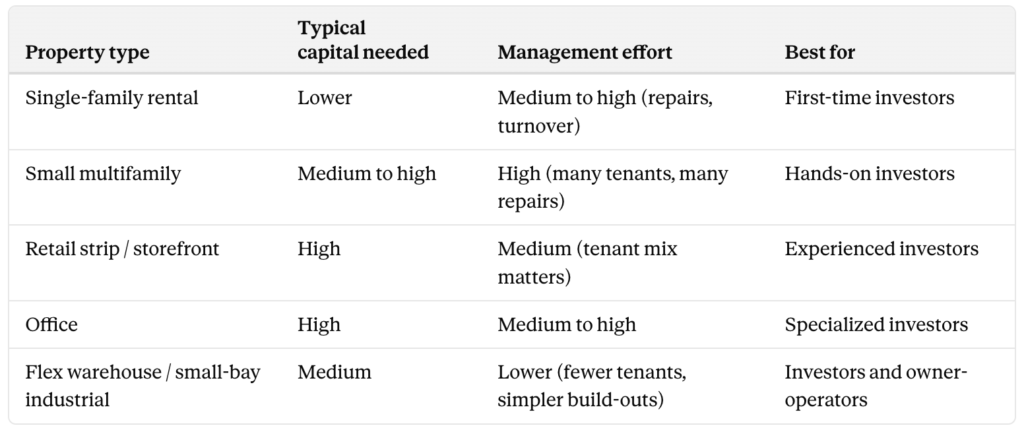
General guidance only. Actual costs and effort vary by property, location and lease terms.
Single-family rentals
The classic starting point. Entry prices in San Antonio are lower than in many large metros: the median owner-occupied home value in Bexar County is $262,200 (Census ACS 2020–2024). The trade-off is hands-on management, frequent turnover and repair calls that come at any hour.
Multifamily
More units mean more income streams, but also more tenants, more maintenance and more regulation. Multifamily usually rewards investors with experience and a property management team.
Retail and office
Retail depends heavily on location and tenant mix. Office has faced uncertainty since remote and hybrid work became common. Both can work, but they typically require larger capital and deeper market knowledge.
Flex warehouse and small-bay industrial
Flex units combine warehouse space with room for an office or showroom. They serve contractors, distributors, e-commerce sellers, service companies and light manufacturers, a huge market in a state with roughly 3.5 million small businesses (SBA Office of Advocacy, 2025 profile). Why buyers are looking at flex:
- Two paths in one asset. Lease it out for income, or occupy it yourself and stop paying rent.
- Simpler tenant relationships. Business tenants generally use the space for operations, not living, which typically means fewer service calls.
- A growing market. In San Antonio, asking industrial rents rose 5.0% year over year to $8.81 per sq. ft. in Q3 2026, and net absorption reached 796,000 sq. ft. (CBRE).
Five questions to ask before you buy
1. How much capital do I want to commit, and how quickly? Some projects offer staged payment structures.
2. How involved do I want to be? Be honest about how much time you have for tenants and maintenance.
3. Who is my tenant, or am I the tenant? Think about who needs this space and why.
4. Is the location built for that tenant? For flex space, highway access and proximity to customers matter more than foot traffic.
5. What is my exit plan? Know whether you plan to hold, sell or pass the asset on.
Explore the Full FBH Developers Portfolio
Nacogdoches Flex Business Hub is one of several projects by FBH Developers.
Our portfolio also includes:
- Marbach Flex Warehouse
- Cable Ranch Business Hub
- Railway
- Amelia Pass
Each project has its own location, timeline and availability. Visit our Projects page to compare them and find the one that best fits your investment or business goals.
Find the property that fits your plan
Whether you are buying for income or to house your own business, we can walk you through the numbers.
